Call for Participants — Symposium on Studying Contemporary Canadian Publishing: Politics, Futures, Interventions

Call for Participants — Symposium on Studying Contemporary Canadian Publishing: Politics, Futures, Interventions

May 11–13, 2026, The Banff Centre for Arts and Creativity, Alberta (dates TBC)

Deadline: Jan. 20, 2026 (Pacific Time)

Symposium organizer: Julie Rak (University of Alberta)

Keynote: Claire Squires, Director of the Stirling Centre for International Publication and Communication (University of Stirling, Scotland)

The study of Canadian and Quebec publishing was well-served by Carole Gerson and Jacques Michon’s History of the Book in Canada, Volume 3: 1918–1980. But much has happened in publishing since that volume’s release almost two decades ago Mergers, the explosion of online and self-publishing platforms, shifts in popular taste toward genres like YA, BIPOC publishing, the rise of awards culture, government censorship, and changes to Canada’s international standing in the book trade have all contributed to a much-changed publishing landscape. Unlike in Australia, which has a robust critical discourse on contemporary publishing, with large scholarly projects like Genre Worlds: Australian Popular Fiction in the 21st Century, and in Scotland, where the University of Stirling offers a research PhD on the study of publishing, the scholarship of contemporary publishing in Canada has focused on publishing houses or on case studies by individual scholars. It is time to build on Canadian work in publishing, together. The field of Canadian and Quebec literatures and our classrooms need a scholarly intervention focused on the politics, history, economics, and culture of the current publishing landscape.

The Canadian Publishing symposium, to be held at the Banff Centre for the Arts, will have two parts:

  1. On Day One, attendees will present short papers to share findings and will hear a keynote by Dr. Claire Squires, author of Marketing Literature: The Making of Contemporary Writing in Britain (2007)and director of Scotland’s oldest publishing program for postgraduates.
  2. On Days Two and Three, attendees will participate in writing workshops to begin developing their short papers into authored or co-authored submissions for a Canadian Literature special issue on contemporary publishing. After the symposium, finalized workshop drafts will be submitted for the special issue and undergo the journal’s standard peer-review process. If there are more publishable submissions than Canadian Literature can accept, or if longer-term work is needed for any given submission, we’ll make a long-range publishing plan too.

Topics for the symposium include:

  • Censorship and Canadian publishing
  • Scandals
  • Indigenous publishing
  • Book fairs and awards
  • Agents and editors
  • Contemporary publishing and EDI
  • Cultural policy and the state of publishing in Canada and Quebec
  • Money, political economy, and publishing now
  • Publishing and radical politics
  • Online platforms and self-publishing
  • Publishing and popular genres (e.g., romance, mystery, YA)

Submission Guidelines

Want to participate in the symposium? Submit a 200-word abstract and a 50-word bio to Julie Rak at jrak@ualberta.ca by January 20, 2026 (PT). You will hear back by February 20, 2026. Financial support for early career scholars will be available. Submissions may be in French or English.

Contact Us

Feel free to contact us with any questions or concerns.

Call for Papers — Authoritarianism, Anti-fascism, and Literary Resistance

Deadline: June 1, 2026 (Pacific Time)

Submission length: 7,000-8,000 words (including works cited and notes) in English or French

Guest Editors: Anna Branach-Kallas (Nicolaus Copernicus University in Toruń) and Laura Moss (University of British Columbia)

When the revised and expanded edition of ANTIFA Comic Book: 100 years of Fascism and Antifa Movements was published in the summer of 2025, few would have been surprised about the sheer volume of content that its creator Gord Hill, of the Kwakwaka’wakw nation, had to cover in the eight years since the original version was launched.  

Far-right and authoritarian political ideologies are now pervasive in many parts of the world. The last few years have seen a rise in extreme forms of nationalism, an increase in propaganda, the censorship of individual words, lists of banned books, growing militarism, the rejection of the value of diversity and inclusion, and anti-democratic movements gaining traction. Concomitantly, however, resistance is also globally prevalent. One forum for resistance is art. In this special issue, we ask how writers, critics, and artists are addressing/ countering authoritarianism in their artistic practice or how they’ve done so in the past.   

We ask, what do fascist leaders and authoritarian forms of government target that we, as literary and cultural scholars, can address? Historian Timothy D. Snyder argues that “Fascism is about constructing reality by way of spectacle, by way of technology” enlisting the “dramaturgy of good and evil.” In literary studies, we are trained to critique spectacle, to spot over-worn narratives, to put pressure on binaries, and to unsettle oppositions. That is, we often think about contextualized histories, the resistant power of complex and poetic language, and the role of creativity in countering silencing. If specific words or books are banned, how do we respond? This is our wheelhouse and this is precisely where the creative humanities needs to come in.

This is not a new issue in Canada; historical works treat fascism and anti-fascism just as forcefully as contemporary ones. For instance, historian Lita-Rose Betcherman argues in The Swastika and the Maple Leaf, that “in Canada fascism was a minor but persistent theme throughout the decade of the thirties.” The subsequent anti-fascist ideas and movements of the thirties developed to counter the spread of antidemocratic forces and reactionary politics. The global anti-fascist cause of the Spanish Civil War provoked much enthusiasm and support in Canada, and had a substantial impact on Canadian literature and culture. As scholar Emily Robins Sharpe contends, “envision(ing) Canada via Spain” allowed Canadian writers such as Ted Allan, Charles Yale Harrison, and Hugh Garner to articulate their discontent and hope for “a better earth.” With the outbreak of the Second World War, Canadian fascists were interned and anti-Nazism defined mainstream politics in Canada. Yet fascism acquired new facets in North America in the post-war period. These different (anti-)fascist traditions may take on new meaning today.

This special issue of Canadian Literature will examine literary and artistic approaches to fascism and anti-fascism in Canada, moving beyond traditional understandings of these terms. We are interested in (anti-)fascist encounters in any period. What (anti-)fascist memory layers can be found in Canadian literature, film, and the visual arts? What specific responses to fascism and anti-fascism have been created in Canada? How have writers and artists reconceptualized ideas that developed in Europe and the United States? Do engagements with (anti-)fascism in English Canadian literary traditions differ from engagements in Québec? Should anti-fascism be defined as including resistance to capitalism? Can anti-colonialism and anti-racism be understood as anti-fascism? What is the potential of authoritarianism to (dis-)connect communities? Where are fascist and anti-fascist politics practiced today? Finally, how does Canadian art and culture “seek anti-fascist departures,” in the words of essayist Natasha Lennard, when confronted with “the micro-fascisms” present in everyday lives?

We invite papers of 7,000-8,000 words, in English or in French, that join us in contemplating Canadian fascist and anti-fascist literary, visual, and artistic articulations.

Topics articles might consider: 

  • Anti-fascist communities
  • Anti-fascist entanglements and continuities
  • Anti-fascist resistance: struggles and victories
  • Authoritarian power
  • Banned books 
  • Banned words (and the impact on the environment or gender politics)
  • Censorship
  • Disruptions to civil rights and civil liberties  
  • Dystopias and utopias
  • Fascist histories and stories of living in them
  • Fleeing authoritarian rule
  • Genres of resistance (allegory, satire, speculative fiction)
  • Global struggles
  • Identities under censure
  • Insecurity and uncertainty in fascist encounters
  • Life narratives and memoirs
  • Local or transnational antifascist solidarities
  • On being targeted
  • Political migration
  • Propaganda
  • Radical hope
  • Rise in nationalism and strategic nationalisms
  • Religion and politics
  • Sexualities and genders under threat
  • Threats to the rule of law

Works Cited

Betcherman, Lita-Rose. The Swastika and the Maple Leaf. Fitzhenry & Whiteside, 1978.

Hill, Gord. The ANTIFA Comic Book: 100 years of Fascism and Antifa Movements Revised and Expanded. Arsenal Pulp Press, 2025.

Lennard, Natasha. Being Numerous: Essays on Non-Fascist Life. Verso 2019.

Sharpe, Emily Robins. Mosaic Fictions: Writing Identity in the Spanish Civil War. U of Toronto P, 2020.

Snyder, Timothy D. “Recognizing the Signs of Fascism Today: Interview with Eli Glasner.” CBC News, May 29, 2025.  https://youtube.com/watch?v=7PcxC1p-Z-g. Accessed May 30, 2025.   

Submission Guidelines

Submissions should be sent online through our Open Journal Systems (OJS) portal.

All submissions to Canadian Literature must be original, unpublished work. Essays should follow current MLA bibliographic format (MLA Handbook, 9th ed.).

Please limit images accompanying submissions to those receiving substantial attention in the article. Contributors will be required to obtain permission to reproduce images in their article and pay for any permission costs. The journal will provide a template for permission requests; such requests must be completed before publication. Please send high-quality images as separate attachments along with your article file.

Please review our full submission guidelines prior to submitting.

Contact Us

Feel free to contact us with any questions or concerns.

New Issue: 260 — General

We are thrilled to announce our newest issue of Canadian Literature, Issue 260! In her last Canadian Literature editorial, outgoing Editor-in-Chief Christine Kim writes:

When I first took up the role of editor-in-chief at Canadian Literature in July 2020, we were in the midst of a global pandemic. As I prepare to wrap up my term as editor and reflect on the past five years, I’m conscious that the turbulence unleashed by the pandemic never disappeared. Instead, grief, fear, anxiety, and anger continued with global conflicts that include, but are not limited to, the devastation being inflicted on the Gaza Strip, the invasion of Ukraine, and the terrors being experienced within the US in a myriad of ways, including deportations without just cause. Within this new epoch of history, what has Canadian literature come to mean and what, moreover, does it do? How have the field and the journal been transformed over the years? These questions of framing and context are ones that I’ve thought deeply about in order to figure out who the reader of Canadian Literature is or isn’t, or could perhaps be, as well as what my own relationship to the field is these days.

— “From Then to Now

This issue also features:

The new issue can be ordered through our online store at https://canlit.ca/support/purchase/single-issues/.

New Issue: 258/259 — How to Be at Home in Canada: Placemaking in Indigenous, Diasporic, and Settler Texts

We are thrilled to announce our newest issue of Canadian Literature, Issue 258/259, a special double issue on How to Be at Home in Canada: Placemaking in Indigenous, Diasporic, and Settler Texts! In this issue’s editorial, guest-editors Heather Macfarlane, Sophie McCall, and Basmah Rahman write:

Diasporic populations negotiate complex relationships between their ancestral lands of origin and adopted homeland of Canada, which, while it claims to welcome diversity through its multicultural policies, systemically excludes Indigenous, Black, and racialized populations. Indigenous communities struggle to escape the colonial project of Canadian nationhood while asserting their own sovereign affiliations and rights to land. White settler populations, meanwhile, undertake the contradictory task of acknowledging their history as colonizers while simultaneously finding a place of belonging. The articles in this double issue consider narratives from communities in Canada that assert or contest relations between land, story, ownership, and belonging—in both rural and urban environments, and in forms as varied as traditional Indigenous stories, religious documents, poetry, prose fiction, and government policy.

— “Entangled Belongings

This issue also features:

  • Articles by Kristina Fagan Bidwell, Isabella Huberman, Sarah Wylie Krotz, Jhordan Layne, Nicole Flores, Melanie Braith, Basmah Rahman, Olivia Abram, Jaron Judkins, Laurel Ryan, and Tianne Jensen-DesJardins
  • Poetry by Suha Kudsieh, Tannaz Taghizadeh, Susan McCaslin, Padmaja Battani, Anna Veprinska, Joanne Epp, Jen Colclough, Derek Webster, Shyanne MacDonald, Ling Ge, Jeevan Bhagwat, and J. Iribarne
  • Book reviews by Neil Surkan and Alessandra Capperdoni

The new issue can be ordered through our online store at https://canlit.ca/support/purchase/single-issues/.

Excitingly, we’ll be hosting a virtual launch for this special issue on Friday, June 20th, 2025, at 11am (PST) / 2pm (EST)! The event will be held over Zoom, and is free and open to all. Please RSVP here by Friday, June 13th.

Call for Papers — Suburb Nation

— SUBMISSIONS CLOSED —

Deadline: August 15, 2025 (Pacific Time)

Submission length: 7,000-8,000 words (including works cited and notes) in either English or French

Guest Editors: Zishad Lak (Trent University), Cheryl Lousley (Lakehead University), Paul Barrett (University of Guelph), Cheryl Cowdy (York University)

Canadian fiction, film, and television increasingly abound with representations of suburban life, such as Sort Of, co-created by and starring playwright Bilal Baig; Run the Burbs, co-created by and starring Andrew Phung; the film adaptations of Catherine Hernandez’s novel Scarborough and David Chariandy’s novel Brother; Larissa Lai’s speculative post-Greater Vancouver novels Salt Fish Girl and Tiger Flu; and Mona Awad’s 13 Ways of Looking at a Fat Girl, a collection of linked stories mostly set in “Misery Saga, which is what you’re allowed to call Mississauga if you live there” (1). Foregrounding the lives of people of colour, often first- and second-generation immigrants, these recent depictions centre the suburbs in Canadian experience, offering more varied representations than the stifling, empty periphery of earlier treatments, such as Margaret Atwood’s Cat’s Eye, Barbara Gowdy’s Falling Angels, or even Dionne Brand’s What We All Long For. In her monograph Canadian Suburban, Cheryl Cowdy quotes the speaker in Brand’s long poem Thirsty to describe how Canadian suburban imaginaries are marginalized by the assumption that the suburbs are “prefabricated from no great narrative” (xii). They seemingly lack culture and are rarely associated with “dissident artistic or poetic expression,” Cowdy points out; more often, suburbs serve as the butt of jokes and are seen as fertile ground for comedians, such as Mike Myers, Jim Carrey, and the pop band The Barenaked Ladies (xii).

This special journal issue will examine literary approaches to suburban life in Canada across a range of mediums, genres, and periods, paying attention to the suburbs as both an imaginative and a material form. We are especially interested in considering how the mid-twentieth-century popular representation of the suburb as a white, middle-class, automobiled enclave has been written otherwise across varied experiences of racialization, diaspora, and generation—and in the era of fossil-fueled climate change. What dreams and diasporas land immigrants and Indigenous people in suburbs? What histories are disrupted and which are forged in suburban lives and spaces? How do queer and trans people find and write themselves through suburbia? What other places and social lives are relationally entangled in the suburbs—in social connections, in memory, in colonial displacements, and in material economies of labour, production, consumption, waste, and emissions? How are suburban arrivals and departures—and pasts and futures—narrated? What poetic practices engage suburban form and its social relations?

We invite papers of 7,000-8,000 words, in English or in French, that join us in asking: If Canada is a suburban nation, what are its suburban stories?

—————

Les créations canadiennes et québécoises en littérature, au cinéma et à la télévision mettent de plus en plus en scène la vie en banlieue. Des œuvres comme Sort Of, co-créé par le dramaturge Bilal Baig, Run the Burbs, co-créé par Andrew Phung, ainsi que les adaptations cinématographiques des romans Scarborough de Catherine Hernandez et Brother de David Chariandy, en témoignent. Les œuvres littéraires spéculatives telles que Salt Fish Girl et Tiger Flu de Larissa Lai, qui se déroulent dans une Vancouver post-métropolitaine, ainsi que 13 Ways of Looking at a Fat Girl de Mona Awad dont l’intrigue se situe principalement dans la ville de Mississauga surnommée « Misery Saga », participent également à cette tendance. Cette tendance a également commencé à prendre son élan au Québec avec la publication de Sainte-Foy du poète et rappeur Akena Okoko, ainsi que les nouvelles de Nicholas Dawson et de Marilou Craft dans Cartographies I et Cartographies II,deux ouvrages collectifs sur les couronnes nord et sud de Montréal.

En mettant l’accent sur la vie des personnes racisées, souvent issues de l’immigration ou de parents immigré.es, ces œuvres récentes recentrent la banlieue dans l’expérience canadienne. Elles proposent une vision plus diversifiée que celles des représentations antérieures, qui dépeignaient la périphérie comme un espace étouffant et vide, à l’image de Cat’s Eye de Margaret Atwood, Falling Angels de Barbara Gowdy, What We All Long For de Dionne Brand ou encore Le ciel de Bay City de Catherine Mavrikakis. Dans son livre Canadian Suburban, Cheryl Cowdy cite le narrateur du long poème Thirsty de Brand pour montrer comment la représentation stéréotypée des banlieues canadienne est souvent « préfabriquées à partir d’un grand récit » (xii). Selon Cowdy, les banlieues dans ces récits manquent généralement de culture et sont rarement associées à une « expression artistique ou poétique dissidente ». Au contraire, elles servent souvent de cible pour les blagues et sont considérées comme un terraux propice aux humoristes tels que Mike Myers, Jim Carrey ou le groupe de musique pop The Barenaked Ladies (xii).

Ce numéro spécial de la revue explore les approches littéraires de la vie en banlieue au Canada et au Québec à travers divers médiums, genres et époques. Il envisage la banlieue tant comme une forme matérielle et que comme un espace imaginaire. Nous nous intéressons particulièrement à la manière dont la représentation dominante des banlieues, au milieu du XXe siècle, comme des enclaves blanches, de classe moyenne et centrées sur l’automobile, a été réécrite à travers des expériences de racialisation, de diaspora et de génération – ainsi qu’à l’ère du changement climatique alimenté par les combustibles fossiles.

Quel sont les rêves et les trajectoires diasporiques amènent les immigrants et les personnes autochtones dans les banlieues? Quelles histoires s’y voient interrompues lesquelles y prennent forme? Comment les personnes queer et trans s’y inscrivent-elles et s’y écrivent-elles? Quels autres lieux et formes de sociabilité s’entremêlent avec la vie en banlieue – à travers les réseaux sociaux, la mémoire, les déplacements coloniaux et les économies matérielles du travail, de la production, de la consommation, des déchets et des émissions? Comment les histoires des arrivées et des départs, des passés et des avenirs y sont-elles racontées? Quelles poétiques s’emparent de la forme suburbaine et de ses dynamiques sociales?

Nous sollicitons des textes de 7 000 à 8 000 mots, en anglais ou en français, qui nous aident à explorer cette question : si le Canada est une nation suburbaine, quels sont ses récits suburbains?

Submission Guidelines

Submissions should be sent online through our Open Journal Systems (OJS) portal.

All submissions to Canadian Literature must be original, unpublished work. Essays should follow current MLA bibliographic format (MLA Handbook, 9th ed.).

Please limit images accompanying submissions to those receiving substantial attention in the article. Contributors will be required to obtain permission to reproduce images in their article and pay for any permission costs. The journal will provide a template for permission requests; such requests must be completed before publication. Please send high-quality images as separate attachments along with your article file.

For full submission guidelines, please visit canlit.ca/submissions.

Contact Us

Feel free to contact us to discuss ideas ahead of time.

Guest Editors:

Zishad Lak (zishadlak@trentu.ca)

Cheryl Lousley (clousley@lakeheadu.ca)

Paul Barrett (barrettp@uoguelph.ca)

Cheryl Cowdy (ccowdy@yorku.ca)

Editor-in-Chief: Mary Chapman (canlit.editor@ubc.ca)

General Inquiries: can.lit@ubc.ca

Works Cited

Awad, Mona. 13 Ways of Looking at a Fat Girl. Penguin, 2016.

Cowdy, Cheryl. Canadian Suburban: Reimagining Space and Place in Postwar English Canadian Fiction. McGill-Queen’s UP, 2022.

Références

Awad, Mona. 13 Ways of Looking at a Fat Girl. Penguin, 2016.

Cowdy, Cheryl. Canadian Suburban: Reimagining Space and Place in Postwar English Canadian Fiction. McGill-Queen’s University Press, 2022.

Craft, Marilou. « Île Jésus (H7L) ». Cartographies II : Couronne Nord. La mèche, 2017.

Dawson, Nicholas. « Auprès des moufettes ». Cartographies I : Couronne Sud. La mèche, 2016.

Mavrikakis, Catherine. Le ciel de Bay City. Héliotrope, 2011.

Okoko, Akena. Sainte-Foy. Éditions de Ta Mère, 2019.

New Issue: 257 — General

Happy New Year, all! We are thrilled to announce our newest issue of Canadian Literature, Issue 257! In this general issue’s editorial, Editor-in-Chief Christine Kim writes,

“Many of the contributions to this issue offer ways of rethinking the ways in which history and literature inform each other. By turning to Indigenous literatures and languages, diasporic writing, and canonical Canadian literature, the essays and forum pose generative questions about the reading, writing, and teaching of Canadian literatures and histories. . . . Taken together, these essays and forum contributions push us to reflect upon the stories we construct about the past and the histories we routinely draw upon, the conventions that guide these storytelling practices, and our positionality as teachers, writers, and readers.”
— “History x Literature

This issue also features:

The new issue can be ordered through our online store at https://canlit.ca/support/purchase/single-issues/. Happy reading!

Call for Papers — Solidarity: Aesthetics, Politics, Pedagogies

— SUBMISSIONS CLOSED —

Deadline: March 31, 2025 (Pacific Time)

Submission length: 3,000-5,000 words (including works cited and notes)

Guest Editors: Smaro Kamboureli (University of Toronto)

If man is ever to solve the problem of politics in practice he will have to approach it through the problem of the aesthetic, because it is only through beauty that man makes his way to freedom.

Friedrich Schiller, On the Aesthetic Education of Man

Leanne, I’m with you here: we deserve forms of homespace that allow life, in all of its forms, to proliferate. This belief—a shared politic—is what grounds my solidarity with you and yours. It is not contingent on reciprocity. I will forever choose to align, politically, with those who would continue to work toward liberated territories, bodies, lives, and homespaces, in whatever form that takes. Against any form of governance that relies on land dispossession, that renders some of us criminal, alien, or forced to the constitutive outside of belonging.

I believe in forging a shared politic.

Robyn Maynard to Leanne Betasamosake Simpson, Rehearsals for Living

Solidarity: Aesthetics, Politics, Pedagogies aims at examining how solidarity as a product of imagination and praxis might help scholars address the incommensurability of conflicts inside and outside texts as well as inside and outside the classroom and academia at large. Although it is famously difficult to theorize solidarity or describe it as lived experience, it is commonly understood as a condition of relationality and intersectionality—being in relation with different human and non-human communities. Historically considered a response to crisis, especially in the arenas of politics and labour relations, solidarity promises transformation in the name of justice. Yet it can also find itself mired in ambiguity, moral complicity, even controversy. Thus, engendered by and responsive to crisis, solidarity responds to vulnerability, but can also become vulnerable itself (Kamboureli 2).

This special issue invites contributions that focus on the analytic value of solidarity as the prism through which we situate ourselves in academia as teachers, critics, students, or administrators, especially during times marked by competing calls for solidarity. Here, aesthetics is offered not in its Kantian sense of aesthetic disinterestedness, but in relation to the term’s Greek origin, namely, aesthesis (αισθησης), meaning perception through the senses, feeling, affect, sensation, lived and imagined experience. In this light, the aesthetic is what brings together the individual and community, and it is through this alliance that it can engage with politics. If solidarity is to gesture toward emancipatory politics, it needs, to evoke Roy Miki, “an aesthetics that both acknowledges the colonialism embedded in Canadian cultural nationalism and draws attention to a ‘present-tense’ relationship to the lands that were appropriated” (164).

This special issue welcomes single-authored or collaborative scholarly articles, but also submissions that push against the boundaries of conventional academic writing by blending, for example, the theoretical and the autoethnographic. The contributions need not be limited to the study of literature or to the present moment. The topics may include, but are not limited to, the following:

  • Professing literature and criticism while being engaged with or remaining mindful of the crises outside the classroom at any given moment
  • Reading texts, literary or not, that transform rather than represent the world
  • Inscriptions of solidarity in literatures in Canada
  • Discursive formations and practices of solidarity, especially in relation to academia
  • Influences on your decision to teach or not to teach “difficult” texts (e.g., texts that may trigger various kinds of discomfort)
  • Negotiating your sense of bearing witness and accountability with the heterotopic spaces of the classroom or social media
  • Whether solidarity can be fostered pedagogically
  • Negotiating different “regimes” of attention and engagement
  • The pleasures and perils of declaring, or not declaring, solidarity
  • Solidarity, unspoken threats, and the culture of intimidation
  • From empathy to solidarity
  • Solidarity with/between specific communities
  • Collective and individual expressions as practices of solidarity in relation to cultural production
  • What to do with “ugly feelings” (Sianne Ngai) in texts and/or classrooms, committee rooms, public assemblies, etc.
  • Performing social justice, woke culture, and/or cancel culture on or off the campus
  • The ethics, politics, and aesthetics of vulnerability
  • Reflections on supporting, or just visiting, or staying away from, a pro-Palestinian student encampment
  • The aesthetics of pro-Palestinian student encampments and/or the aesthetics of pro-Israeli presence on campus
  • The Palestinian exception (suppressing Palestinian advocacy) on campuses
  • Solidarity and the politics and aesthetics of visuality
  • The aesthetics, politics, and limits of EDI policies

Submission Guidelines

Submissions should be sent online through our Open Journal Systems (OJS) portal.

All submissions to Canadian Literature must be original, unpublished work. Essays should follow current MLA bibliographic format (MLA Handbook, 9th ed.).

Please limit images accompanying submissions to those receiving substantial attention in the article. Contributors will be required to obtain permission to reproduce images in their article and pay for any permission costs. The journal will provide a template for permission requests; such requests must be completed before publication. Please send high-quality images as separate attachments along with your article file.

For full submission guidelines, please visit canlit.ca/submissions.

Contact Us

Please feel free to contact the journal editor, Christine Kim (cl.editor@ubc.ca), or the special issue guest editor, Smaro Kamboureli (smaro.kamboureli@utoronto.ca), to discuss ideas ahead of time. General questions about the special issue may be directed to can.lit@ubc.ca.

Works Cited

Kamboureli, Smaro. “Introduction I: Literary Solidarities: ‘Should I Be Here?’” University of Toronto Quarterly, vol. 89, no. 1, winter 2020, pp. 1–22.

Miki, Roy. “Afterword: Roy Kiyooka as/in Tom Thomson.” The Artist and the Moose: A Fable of Forget, by Roy K. Kiyooka, LINEbooks, 2009, pp. 135–77.

Ngai, Sianne. Ugly Feelings. Harvard UP, 2005.

Roy Miki

It is with great sadness that we mourn the passing of Dr. Roy Miki (1942–2024). Roy was a visionary who made groundbreaking contributions to the field of Canadian literature and helped shape some of the pressing debates of our time. He will be remembered as a brilliant scholar and poet, a committed activist on behalf of racialized communities, a courageous public intellectual, and, above all, a generous, kind, and beloved teacher and mentor. 

Roy made many bold interventions in Canadian literary and cultural studies, including in his roles as an organizer of the Writing Thru Race conference; chairman of the Racial Minority Writers’ Committee of the Writers’ Union of Canada; co-chair (with Smaro Kamboureli) of the inaugural TransCanadas conference; founder of the journal Line, which later merged with West Coast Review to become the journal West Coast Line, which Roy edited; and a driving force behind the establishing of SFU’s Writer-in-Residence program. These projects offered critical and creative critiques of institutions and fields, with their exclusionary practices and foundations, and made space for previously excluded Canadian communities grounded in principles of social justice and creative practice.

Roy was a founding figure in the field of Asian Canadian studies who influenced generations of thinkers with his articles and monographs, including Broken Entries: Race, Subjectivity, and Writing (1998) and In Flux: Transnational Shifts in Asian Canadian Writing (2011). During the 1980s, he was a member of the negotiating team from the National Association of Japanese Canadians, which reached a landmark redress agreement with the Canadian government; he chronicled this process in Redress: Inside the Japanese Canadian Call for Justice (2004). In addition to numerous works of criticism and scholarship, Roy published six books of poetry, including a collected edition of his works, Flow (2018). Among his many awards and honours, he was the recipient of a Governor General’s Award for Surrender (2001), and he was appointed to the Order of British Columbia and the Order of Canada. Roy also had a long teaching career at Simon Fraser University, where he trained a generation of critics and writers in Canadian literature, Asian Canadian studies, and contemporary literature.

Roy published an article entitled “Global Drift: Thinking the Beyond of Identity Politics” in Canadian Literature as part of a special issue on Asian Canadian studies (issue 199, 2008), guest edited by Guy Beauregard. His writing also appears in a collectively authored epilogue to that issue. “After Redress: A Conversation with Roy Miki” is an interview with Roy by Guy Beauregard (issue 201, 2009). In addition, two of Roy’s poems, “Winnipeg c. 1950” and “on the sublime,” appear in another special issue on Asian Canadian writing, guest edited by Glenn Deer (issue 163, 1999).

Please also see this piece by our poetry editor, Phinder Dulai, written in memory of Roy and published in periodicities: a journal of poetry and poetics.

Call for Papers — Emerging Scholars: Knowledge Production in Crisis

SUBMISSIONS CLOSED

EXTENDED Deadline: Mar. 31, 2025 (Pacific Time)

Submission length: 5,000-8,000 words (including works cited and notes)

Guest Editors: Z. N. Dylan Jackson, amanda wan, Emma Gilroy (University of British Columbia)

In “Mistaken Identity: ‘Asian Indigenous Relation’ and the Afterlives of Feminist Critique” (2023), Rusaba Alam observes that close textual analysis has “fallen out of favour in a contemporary scholarly field conditioned by precarity and by the ever-diminishing time and space available for sustained attention to language” (79). Even as analytical methods—in Alam’s example, deconstruction—have facilitated feminist, queer, and other liberatory critiques, those of us who would practice them find ourselves stymied by the demands of the very institutions that would enable us. To be an emerging scholar in Canada or Canadian literature would seem to be exciting: an honour, an opportunity, an affective praxis of intellectual home- and community-making. To work as an emerging scholar, however, is an increasingly difficult proposition..

We gesture here to the so-called crisis in the humanities, or the vocational stress that has been steadily increasing in academia over decades. Literary study in its own right often attends to crises of content, form, or milieu. Yet the impossibility of containing scholarly crises within conventional scholarly contexts grows more obvious, and more pressing, every day. The three of us—Z. N. Dylan Jackson, amanda wan, and Emma Gilroy—are ourselves emerging scholars, currently studying in or having recently graduated from the English department at UBC and working as members of CanLit’s editorial collective. Working at CanLit and in CanLit has driven us to reconsider how to join ongoing conversations within, and in response to, the academic institution. For example, the 2024 Congress of the Social Sciences and Humanities at McGill University saw dozens of Canada’s scholarly organizations gather for an event whose host stood at odds with its own students and faculty. This controversy signalled the material dimensions of making and finding home and community on already politicized ground, illuminating tensions among the university and genocide, carcerality, colonialism, protest, mutual aid, and solidarity.

Here, then, is a crisis: our knowledge production mediates the colonial and debilitating institutions of the university and, as the writers and editors of Refuse: CanLit in Ruins (2018) have shown, CanLit itself. Some of us have long negotiated or worked to mitigate these hostilities, while others among us may see the vocational ideal of knowledge production newly demystified amid the COVID-19 pandemic or the escalation of genocide in Palestine. In both cases, recent and ongoing crises have crystallized and lent urgency to the tensions of knowledge production in or about Canada as an embodied, emplaced, and affiliated practice.

In this special issue, we invite emerging scholars—graduate and postdoctoral students, early-career scholars, and anyone else who might consider themself an emerging scholar—to reflect on the scholarly crises into and out of which we emerge. How might we navigate the tangle of literary study, knowledge production, and the moral and ethical imperatives of our current cultural moment?

We welcome reflections on the field, praxis-oriented proposals, and other engagements with the matter outlined above. Literary or textual analysis as a mode of engagement is particularly encouraged. We offer the following possible starting points:

  • The home institution: Amid anticolonial encampments for Palestine, graduate worker strikes, an ongoing pandemic, and other events, how does the university as an ambivalent site of knowledge production affect our work and understanding of ourselves as scholars? How might such ambivalence generate possibilities for reshaping both harmful and life-giving practices of home-making within institutions?
  • Poetics and, of, against production: How might we read poetry as a mode of knowledge production? How does poetry produce knowledge differently, produce different knowledges, or speak to more conventional sites of knowledge production?
  • Assimilation and resistance: What happens to alternative ways of knowing when we introduce them into the university? How can we honour these epistemologies by, or rather than, institutionalizing them? What works help you grapple with these questions?
  • Knowledge in, of, and out of place: How are you incorporating land-based pedagogies and methodologies into your knowledge production? How do such modalities attune us to the possibilities of knowledge out of place? How do we reckon with CanLit as a field conditioned by encounters with Indigenous knowledges, in addition to conceptions of Indigeneity that vary throughout the many iterations of settler colonialism and empire?
  • Scholarship beyond the academy: How have you encountered scholarship in, or brought scholarly work into, nonacademic contexts? What texts guide your own visions for non- or new academic models of scholarly home, labour, or community?
  • Undisciplining: How does interdisciplinarity and the undisciplining of literary and textual studies inform your work? What media artefacts help you think through a practice among or beyond disciplines? How might we think about undisciplining as the refusal of discipline?

Submission Guidelines

We hope to help alleviate the pressures of scholarly knowledge production in two ways. First, we are happy to consider shorter (~5000-word) and collaboratively authored articles. Second, we will offer workshop support to authors whose articles are accepted for publication.

Submissions should be sent online through our Open Journal Systems (OJS) portal.

Articles should follow current MLA style and formatting (MLA Handbook, 9th ed.).

Please limit images accompanying submissions to those receiving substantial attention in the article. Contributors will be required to obtain permission to reproduce images in their article and pay for any permission costs. The journal will provide a template for permission requests; such requests must be completed before publication. Please send high-quality images as separate attachments along with your article file.

For full submission guidelines, please visit canlit.ca/submissions.

Contact Us

If you have questions or wish to discuss ideas ahead of time, please feel free to reach out to us:

Guest Editors / General Inquiries: Z. N. Dylan Jackson, amanda wan, Emma Gilroy (can.lit@ubc.ca)

Editor-in-Chief: Christine Kim (cl.editor@ubc.ca)

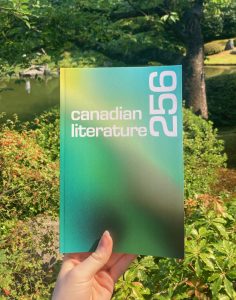
New Issue: 256 — General

We are thrilled to announce our newest issue of Canadian Literature, issue 256! In this general issue’s editorial, Editor-in-Chief Christine Kim writes,

In a recent special issue of Canadian Literature on the theme of
poetics and extraction, editors Max Karpinski and Melanie Unrau
draw attention to “Canada as referring, always problematically, to the
land on and with which we live, the settler-colonial nation-state, and
an ideological cultural project” (5). Considering Canada as an ongoing
colonial and ideological environment, they ask: “[I]n what ways might
cultural production and scholarship in the field of ‘Canadian
literature’ address the unfolding, intensifying, and deeply entangled
environmental and social crises that mark the present moment?” (5). They approach environment through a focus on extractivism, which perceives “not only so-called inanimate resources such as furs and oil but also Indigenous, Black, and People of Colour as extractible” (7). To counter extractivism, which they deem tied to racial capitalism and colonialism, Karpinski and Unrau engage with the pieces in their special issue for how they “contribute to envisioning good, non-extractive ways of living and being in relation” (8). The five articles in this general issue take up the particularities of environment quite differently, addressing place in terms of labour newspaper circulation, rural homosocial community, labour protests, mediated nature, and transnational poetic networks. And yet, each article also engages with the question of what it means to “live and be in relation” in these particular environments.

— “Entangled Environments

This issue also features:

The new issue can be ordered through our online store at https://canlit.ca/support/purchase/single-issues. Happy reading!